Showing posts with label Histoire(CHW3M). Show all posts
Showing posts with label Histoire(CHW3M). Show all posts
Wednesday, 7 May 2014

Thursday, 1 May 2014
Histoire: Débat-L'esclavage en Grèce et Rome antique
Directives:
Chaque élève doit choisir un personnage de l'histoire pour représenter dans le débat.
- Emma - Jules César,
- Dani - Cicéron,
- Sheik - Socrates
Le thème: L'esclavage. Les orateurs peuvent débattre sur n'importe quel sujet d'esclavage qui est relatif à l'époque en question.
NB.
- Ceci n'est pas un débat pour ou contre l'esclavage, mais "should debate the "limits" of slavery"
- "You are debating parts of slavery, for example, should people be allowed to be freed? Should disabled people be exempted? How should slaves be treated better? "
But: Understand that era and the difficulty of creating arguments against parts of slavery.
La procédure du débat sera le suivant :
- Chaque orateur va présenter ses arguments principaux dans le format de débat présenter en cours (pas plus que 10 mins par orateur)
- Chaque orateur aurait ensuite le droit de réponse et peut répondre à quiconque (pas plus que 5 mins par orateur)
- Chaque orateur aurait une réplique finale concernant une réponse donnée (pas plus que 5 mins par orateur)
La structure pour les arguments principaux est la suivante :
- Introduction qui dit qu'est-ce qu'on va débattre et les 3 grands points du débat (D'abord, Ensuite, Enfin).
- Les trois arguments sont discutés. Il faut inclure, pour chaque argument, une citation d'un autre grand personnage. Il faut aussi donné, pour chaque argument, un example de l'histoire.
- Durée: Environ 10 minutes par personne
- Laissez-nous savoir s'il y a des questions!
- Bon débat :)
- Pour mardi, vous allez soumettre la préparation de votre débat. NB d'inclure tes sources. En remettrant votre débat mardi, vous allez avoir le temps à ajouter de l'information à votre conclusion.
Vidéo du débat:
Rubrique et Commentaires:


Tuesday, 29 April 2014

Monday, 7 April 2014
Tuesday, 1 April 2014
Thursday, 27 March 2014
Dépliant: Découvrez L'Égypte Ancienne!
Introduction:
Imagine that you are a resident of Ancient Egypt. You have been employed by the central government to promote tourism as an industry. One of your first tasks is to design a travel brochure. This brochure will be distributed along the trade route linking the Indus Valley with Cairo in Egypt. Your brochures will be distributed in large numbers in Cairo.
This is what you do:
Imagine that you are a resident of Ancient Egypt. You have been employed by the central government to promote tourism as an industry. One of your first tasks is to design a travel brochure. This brochure will be distributed along the trade route linking the Indus Valley with Cairo in Egypt. Your brochures will be distributed in large numbers in Cairo.
This is what you do:
- Prepare a letter-size sheet of paper by folding twice to form a tri-fold brochure.
- That will give you three outside areas, or "panels," to work with and one large area, or "spread," inside.
Prepare your information:
- Review library and Internet resources about the civilization of Ancient Egypt. Extend your knowledge of the region and the culture by carrying out this research.
- Arrange your information according to "topics" based on the assignment. For example, you might gather all information collected about living accommodations that a visitor might expect to find in Egypt; the kinds of terrain a traveler might expect to pass through; modes of transportation; the gifts tourists can expect to buy in the ancient city; and things to see and do in Ancient Egypt.
Tips for designing a brochure:
- Create a colorful and eye-catching cover for your brochure.
- Remember that you want to attract visitors; you will want to present hardship and danger on the journey as excitement and adventure.
- Make your brochure as attractive, appealing, and informative as you can.
- Balance text with illustrations and use plenty of color
Each brochure will be required to include- Trouves des régions intéressantes à visiter. Mentionnez les villes majeures.- décrivez qu'est ce que les gens aiment faire et qu'estce qu'ils font pour se divertir.- expliquez le système religieux et politique brièvement pour qu'es les visiteurs connaissent un peu sur le pays.- trouvez un aspect intéressant de l'egypte que vous pensez pourrait attirer des touristes.- a detailed map of Ancient Egypt- a list of major cities at that time- information about language(s) spoken;- facts about the government;- information about the culture of Ancient Egypt;- types of transportation a visitor would see- how natural geography played an important role in the lives of people;- a hieroglyphic message to be decoded using a hieroglyphic decoder such as The Hieroglyphic Alphabet or Hieroglyphic Decoder.
*Utilise Easybib pour citer vos sources
Travel Brochure Template:
http://designyoutrust.com/2011/07/30-awesome-travel-brochure-template-designs/
Inspirational Ideas:
http://beforeitsnews.com/fine-art/2012/11/35-inspirational-examples-of-travel-brochures-2452924.html
Inspirational Ideas:
http://beforeitsnews.com/fine-art/2012/11/35-inspirational-examples-of-travel-brochures-2452924.html


Tuesday, 11 March 2014
Egypte: Wordle
Activité: Wordle
Pour apprendre plus au sujet des légends, les mythes, les religions and les deities de l'ancienne Égypte vous allez complèter cet activité. Quand vous avez terminé, vous allez le mettre dans votre "Journal de réflection".
Étape 1: Vous allez visiter des sites web qui parle des légends, mythes, religions et deities de l'ancienne Égypte.
Étape 2: Vous allez copier et coller les noms de ces légends, mythes, religions et deities pour créer un Wordle pour représenter les termes. Pour mettre 2 mots ensemble, il faut utililser ceci "~" entre les mots (tilde character ~ between words that go together). Il faut avoir entre 13 et 18 termes. Il faut copier et coller le terme plusieurs fois pour que le mot devient plus grand, comme vous le voyer en bas. Alors, pour les termes plus importants, rendre les mots plus grand. Je vous encourage de le faire en premier dans un document word, car tu ne veux pas perdre tous vos mots
Étape 3: Enregistre votre Wordle comme jpg. or png.
Étape 4: Écrivez la date dans votre journal de réflection: Mardi le 25 mars 2014. Écrivez le titre Légends, Myths, Réligions and Deities.
Étape 5: Insérer votre image.
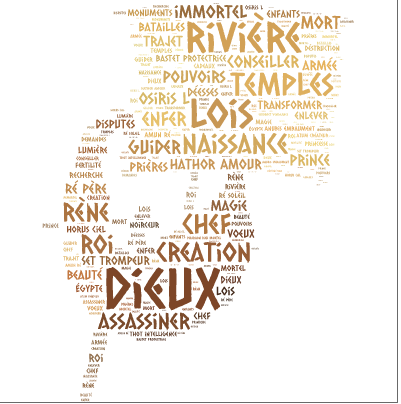
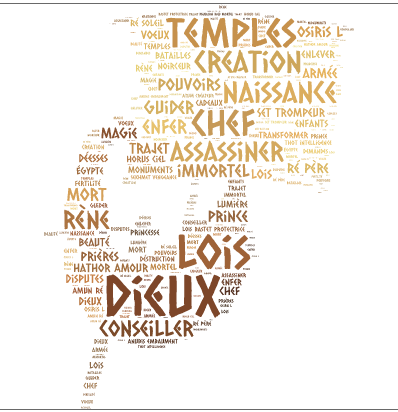
Pour apprendre plus au sujet des légends, les mythes, les religions and les deities de l'ancienne Égypte vous allez complèter cet activité. Quand vous avez terminé, vous allez le mettre dans votre "Journal de réflection".
Étape 1: Vous allez visiter des sites web qui parle des légends, mythes, religions et deities de l'ancienne Égypte.
Étape 2: Vous allez copier et coller les noms de ces légends, mythes, religions et deities pour créer un Wordle pour représenter les termes. Pour mettre 2 mots ensemble, il faut utililser ceci "~" entre les mots (tilde character ~ between words that go together). Il faut avoir entre 13 et 18 termes. Il faut copier et coller le terme plusieurs fois pour que le mot devient plus grand, comme vous le voyer en bas. Alors, pour les termes plus importants, rendre les mots plus grand. Je vous encourage de le faire en premier dans un document word, car tu ne veux pas perdre tous vos mots
Étape 3: Enregistre votre Wordle comme jpg. or png.
Étape 4: Écrivez la date dans votre journal de réflection: Mardi le 25 mars 2014. Écrivez le titre Légends, Myths, Réligions and Deities.
Étape 5: Insérer votre image.
Thursday, 27 February 2014
.JPG)

.JPG)


Tuesday, 25 February 2014
L'Archéologie: Présentation Google Docs et Youtube
Activité 3: Google Presentation (45 minutes)
En groupe, vous allez créer une Présentation Google, en collaboration, qui présent 9 découverts (3 chacun).
Voici l'information que vous allez inclure dans cette présentation:
a) Quelle était la découverte? Quand et ou était-elle découverte? À quelle date remonte-elle la découverte des archéologistes?
b) Décrivez le processus d'excavation.
c) Quelles conclusions étaient tirées à partir de la découverte?
d) Pourquoi cette découverte archéologique était-elle tellement important pour l'histoire?
e) Quelle est la valeur monétaire approximative de la découverte?
f) Quel est un "fait amusant" de la découverte?
g) Trouvez 5 images qui démontrent bien la découverte archéologique.
Vous allez me présenter ceci à la fin de la classe, avant le dîner (11h55)
Les critères:
1 - Il faut avoir une page d'introduction
2 - Il ne faut pas avoir trop de mot sur la page (utilise la section en bas pour vous aidez avec l'explication)
3 - Chaque personne doit présenter 3 découvertes
4 - Ceci est fait en français + Vérifie votre français
6 - Il faut citer vos sources,
En groupe, vous allez créer une Présentation Google, en collaboration, qui présent 9 découverts (3 chacun).
Voici l'information que vous allez inclure dans cette présentation:
a) Quelle était la découverte? Quand et ou était-elle découverte? À quelle date remonte-elle la découverte des archéologistes?
b) Décrivez le processus d'excavation.
c) Quelles conclusions étaient tirées à partir de la découverte?
d) Pourquoi cette découverte archéologique était-elle tellement important pour l'histoire?
e) Quelle est la valeur monétaire approximative de la découverte?
f) Quel est un "fait amusant" de la découverte?
g) Trouvez 5 images qui démontrent bien la découverte archéologique.
Vous allez me présenter ceci à la fin de la classe, avant le dîner (11h55)
Les critères:
1 - Il faut avoir une page d'introduction
2 - Il ne faut pas avoir trop de mot sur la page (utilise la section en bas pour vous aidez avec l'explication)
3 - Chaque personne doit présenter 3 découvertes
4 - Ceci est fait en français + Vérifie votre français
6 - Il faut citer vos sources,
Tuesday, 18 February 2014
Road to Civilization/La Route vers la Cvilization
Class Activity: Road to Civilization:
Instructions:
a) Read your assigned section
b) Using the ipads, each group will take 5-10 pictures that represent specific innovations or changes that occurred which led to the emergence of the world's first communities.
TOPICS:
-> Group 1 (Emma): Hunters and Gatherers (pg. 1-4)
-> Group 2 (Cheik): Learning to Farm and Raise Animals (pg. 1-2)
-> Group 3 (Daniella) The First Communities(pg. 1 - 3)
* You will need to share the iPad so that you make one video. Once the video is complete you will then embed it onto your blog.
Extension of Learning
- Watch: Mesopotamia (10 min)
- Final 5: What are the most influential legacies on the modern world that are derived from ancient civilizations?
- Resource: Traits of a Civilization (prezi)
Instructions:
a) Read your assigned section
b) Using the ipads, each group will take 5-10 pictures that represent specific innovations or changes that occurred which led to the emergence of the world's first communities.
TOPICS:
-> Group 1 (Emma): Hunters and Gatherers (pg. 1-4)
-> Group 2 (Cheik): Learning to Farm and Raise Animals (pg. 1-2)
-> Group 3 (Daniella) The First Communities(pg. 1 - 3)
* You will need to share the iPad so that you make one video. Once the video is complete you will then embed it onto your blog.
Extension of Learning
- Watch: Mesopotamia (10 min)
- Final 5: What are the most influential legacies on the modern world that are derived from ancient civilizations?
- Resource: Traits of a Civilization (prezi)
Voici une vidéo qui démontre la formation des premières communautés.
Here is a video which demonstrates the evolution of the first official communities.
Thursday, 6 February 2014
What Ancient History Means To Me - Daniella
TASK: "Ancient History to Me Means..."
Your first task of the semester is to tell me about yourself and what you will offer to our class this semester. Feel free to address any of the following questions in a 1 page response:
* Check out the website: Flow of History. How familiar are you with some of the 'units' that relate to world history to the 16th century (ie. 1500s)? Which ones interest you the most?
* Do you have a special interest in particular ancient civilziation / person / time period / event? Explain.
* Which ancient civilization are you looking forward to studying? Why?
* Why is it important to study ancient history? What value does it hold to the modern world?
* If you could 'meet' any historical figure from ancient history, who would it be and why?
* Have you seen any recent movies that depict an event / person / civilization in ancient history? For example "Gladiator", "Troy", "300", "Alexander", or "Kingdom of Heaven". What did you enjoy about them? Do you view these movies as 'historically accurate' or pure entertainment?
* Have you ever travelled to areas that are rich in ancient history? Explain. If not, where would you like to travel and why?
* What are your strengths as a student? What are your areas of growth that you need to work on? How can I support you as your teacher?
* What will you contribute to the class, lessons and learning environment?
* What is the meaning of Aldous Huxley's quote: "The charm of history and its enigmatic lesson consists in the fact that, from age to age, nothing changes and yet everything is completely different." Do you agree / disagree?
CRITERIA:
- approximately 1 page single spaced
- can be done in English or French
- size 12 font using Calibri or Times New Roman
- create and save your document in Google Docs with your name in it (ie.Ancient History to Me Means_AlexCarter.doc)
- share your response with alex.carter@acadecap.org and matthew.letourneau@acadcap.org by Wednesday February 5th.
1. Your first task of the semester is to tell me about yourself and what you will offer to our class this semester. What are your strengths as a student? What are your areas of growth that you need to work on? How can I support you as your teacher? What will you contribute to the class, lessons and learning environment?
As an individual, I would consider myself to be hard-working, athletic, and a reader. My preferences in genres are fiction, historical, and historical-fiction – focusing on epidemics, mythology, and wars/revolutions which I discuss with my father since he enjoys this reading topic as well. Athletic wise, I relish in any physical activity that succeeds in providing me an adrenaline rush, as well as physically challenging me. I am currently dancing, practicing the art of jiu-jitsu (self-defence), Brazilian Jiu-jitsu (grappling), and Kickboxing (sparring and conditioning). As for what I will offer to the class; I hope to bring a new perspective and opinion towards certain historical aspects. I hope to live up to your standards, and participate to my full potential throughout discussion amongst producing quality work.
2. Feel free to address any of the following questions in a 1 page response:
· Check out the
website: Flow of History. How familiar are you with some of the 'units'
that relate to world history to the 16th century (ie. 1500s)? Which ones
interest you the most?
website: Flow of History. How familiar are you with some of the 'units'
that relate to world history to the 16th century (ie. 1500s)? Which ones
interest you the most?
I am familiar with nearly all of the units or certain aspects of them. The few which I think I am more informed of are the Birth of Western Civilization, and The Ancient Middle East. The rest I am fairly unknowledgeable, particularly Classical Asia. In terms of interest, my curiosity and appeal apply to nearly all the units. However I do tend to favor the religious/cultural portion, in addition to wars and revolutions of a time period.
· Do you have a special interest in particular ancient civilization / person / time period / event? Explain.
I currently favor Ancient Greece and Rome. I enjoy this time
period because of the social, political, and cultural evolution that occurs.
Learning about life in that time period is simply fascinating, particularly
with their “hero” figures and mythology. In events, I prefer wars.
period because of the social, political, and cultural evolution that occurs.
Learning about life in that time period is simply fascinating, particularly
with their “hero” figures and mythology. In events, I prefer wars.
· Which ancient civilization are you looking forward to
studying? Why?
studying? Why?
I excited to advance my knowledge about more or less, all the
civilizations since I cannot, and do not wish to put a limit to what topics I
would like to learn about. Yes, there are certain aspects of certain units
which I am less excited for compared to others, but I hope that while learning about
them my impression will change.
civilizations since I cannot, and do not wish to put a limit to what topics I
would like to learn about. Yes, there are certain aspects of certain units
which I am less excited for compared to others, but I hope that while learning about
them my impression will change.
· Why is it important to study ancient history? What value does
it hold to the modern world?
it hold to the modern world?
These are two questions which I will be putting on the
Question document for I wouldn’t mind discussing them. I have some ideas as to
what could be the answer(s), such as we can always learn from previous
mistakes.
Question document for I wouldn’t mind discussing them. I have some ideas as to
what could be the answer(s), such as we can always learn from previous
mistakes.
· If you could 'meet' any historical figure from ancient
history, who would it be and why?
history, who would it be and why?
This is a difficult question since the list of possible
historical figures updates very often. I do not think I could specifically choose
one person. Whomever I would choose I ask similar questions such as, “What do
fell/think about women be men’s equals? , How did you come up with such an
invention/theory/plan/etc…?, What are you thinking?, What is your opinion on..?,
What would you change in your life, if you could relive it?, What did it feel
like getting your head cut off?, etc… ”
historical figures updates very often. I do not think I could specifically choose
one person. Whomever I would choose I ask similar questions such as, “What do
fell/think about women be men’s equals? , How did you come up with such an
invention/theory/plan/etc…?, What are you thinking?, What is your opinion on..?,
What would you change in your life, if you could relive it?, What did it feel
like getting your head cut off?, etc… ”
· Have you seen any recent movies that depict an event / person
/ civilization in ancient history? For example "Gladiator",
"Troy", "300", "Alexander", or "Kingdom of
Heaven". What did you enjoy about them? Do you view these movies as
'historically accurate' or pure entertainment?
/ civilization in ancient history? For example "Gladiator",
"Troy", "300", "Alexander", or "Kingdom of
Heaven". What did you enjoy about them? Do you view these movies as
'historically accurate' or pure entertainment?
Although not recently, I have viewed a few of the listed
movies and other historical movies – I favor historical documentaries. When my
family and I watch movies we tend to analyze or criticize the movie; that is
our way of enjoying the movie. Therefore if I were to view a movie such as
Gladiator or Troy, I would analyze what is true, possible, and/or incorrect meanwhile
wondering if it was realistic the way particular concepts or events were done
accurately. If the historical aspects of the movie were fairly well done, then
it boosts my opinion of that movie. If not done properly, then the movie’s
rating drops.
movies and other historical movies – I favor historical documentaries. When my
family and I watch movies we tend to analyze or criticize the movie; that is
our way of enjoying the movie. Therefore if I were to view a movie such as
Gladiator or Troy, I would analyze what is true, possible, and/or incorrect meanwhile
wondering if it was realistic the way particular concepts or events were done
accurately. If the historical aspects of the movie were fairly well done, then
it boosts my opinion of that movie. If not done properly, then the movie’s
rating drops.
· Have you ever travelled to areas that are rich in ancient
history? Explain. If not, where would you like to travel and why?
history? Explain. If not, where would you like to travel and why?
When younger I traveled with my mother and father to Greece,
and visited the tomb of Phillip 2nd of Macedon. I have also been to
Prague, London, Italy(venise&milan), Copenhagen, and Paris where I visited a bit or none of its ancient history landmarks.
and visited the tomb of Phillip 2nd of Macedon. I have also been to
Prague, London, Italy(venise&milan), Copenhagen, and Paris where I visited a bit or none of its ancient history landmarks.
· What is the meaning of Aldous Huxley's quote: "The
charm of history and its enigmatic lesson consists in the fact that, from age
to age, nothing changes and yet everything is completely different." Do you agree / disagree?
charm of history and its enigmatic lesson consists in the fact that, from age
to age, nothing changes and yet everything is completely different." Do you agree / disagree?
Flow Chart:
- Prehistory — Prehistory, the rise of civilization, and the ancient Middle East to c.500 B.C.E
- Prehistory to c.3000 BCE — Unit 1: Prehistory and the rise of Civilization to c.3000 B.C.E. Barely know
- The ancient Middle East — Unit 2: The ancient Middle East (c.3000-323 B.C.E.) Have learnt a bit, but would like to learn more.
- Birth of Western Civilization — Birth of Western civilization: Greece, Rome, and Europe to c.1000 CE One of my favorite historical period, but doesn’t mean I know enough!
- The Ancient Greeks — Unit 3: The Ancient Greeks
- Rome — Unit 4: Rome
- The Early Middle Ages — Unit 5: The Early Middle Ages
- Classical Asia — Classical Asia to c.1800 C.E.: Islam, India, China, and Japan
- Indian History & Civilization — Unit 7: Indian History and Civilization Barely know anything, but I’m really interested in learning!
- Early Chinese Civilization — Unit 8: Early Chinese Civilization Have some knowledge, but not enough.
- Revival of the West — Revival of the West c.1000-1500 C.E.
- High & Later Middle Ages — Unit 10: The High and Later Middle Ages in Europe Have some knowledge, but not enough!
Subscribe to:
Posts (Atom)